
OPU / ICSI (artificial embryo production)
Equine OPU and in vitro embryo production have become extremely popular in mainland Europe. This is because it is a once-off, walk-in procedure that can be performed off-season and at any stage of the mare’s cycle. ICSI embryos freeze very well, and the overall success of this procedure now exceeds that of traditional embryo transfer.
There are, of course, cost implications to consider. Despite the high success rates, it is clear that a percentage of mares and stallions simply do not produce embryos using this technique. Major complication rates associated with OPU are approximately 1 in 1,000, which is lower than those associated with elective castration procedures and are therefore considered rare.
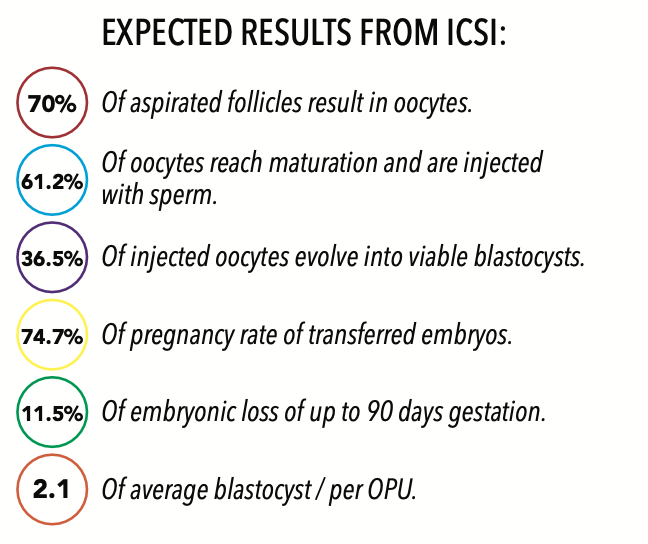
Over three-quarters of OPU sessions produce one or more blastocysts. For mares that produce a blastocyst during their first session, there is a high likelihood of success in subsequent sessions.
The Steps in the Process
Ovum pick-up (OPU) is the procedure by which oocytes (eggs) are collected using a transvaginal, ultrasound-guided technique. This procedure requires specialized equipment and a high level of operator skill. The ideal threshold for this technique is 15 or more follicles measuring between 5 mm and 20 mm in diameter. The procedure can be repeated every three to five weeks.
Following collection, the oocytes are transferred to a laboratory setting. To date in Ireland, oocyte transport has typically occurred via courier to mainland Europe. However, through collaboration between SES Equine Veterinary Services and Genetech UK, oocytes can now be transported by dedicated team member(s) from the registered DAFM OPU collection point at Ballinatone House Stud in Ireland to a UK laboratory, where ICSI is performed.
At the UK laboratory, oocytes undergo in vitro maturation until they reach the stage at which they can be fertilised. Fertilisation is performed by ICSI (intracytoplasmic sperm injection), during which a single sperm is injected directly into the mature oocyte. Embryo development then takes place over a period of seven to ten days under specialised culture conditions. The embryos are subsequently frozen by vitrification, shipped back to Ireland, and later transferred into carefully selected recipient mares at a precisely timed stage.
For more information please do not hesitate to send us an enquiry via our website , email or feel free to call for more information.